There are few things as soul-crushing in the writing process (at least to me) than getting a bunch of characters in a room with the intention of something happening, then the characters proceed to stand around and stare at each other.
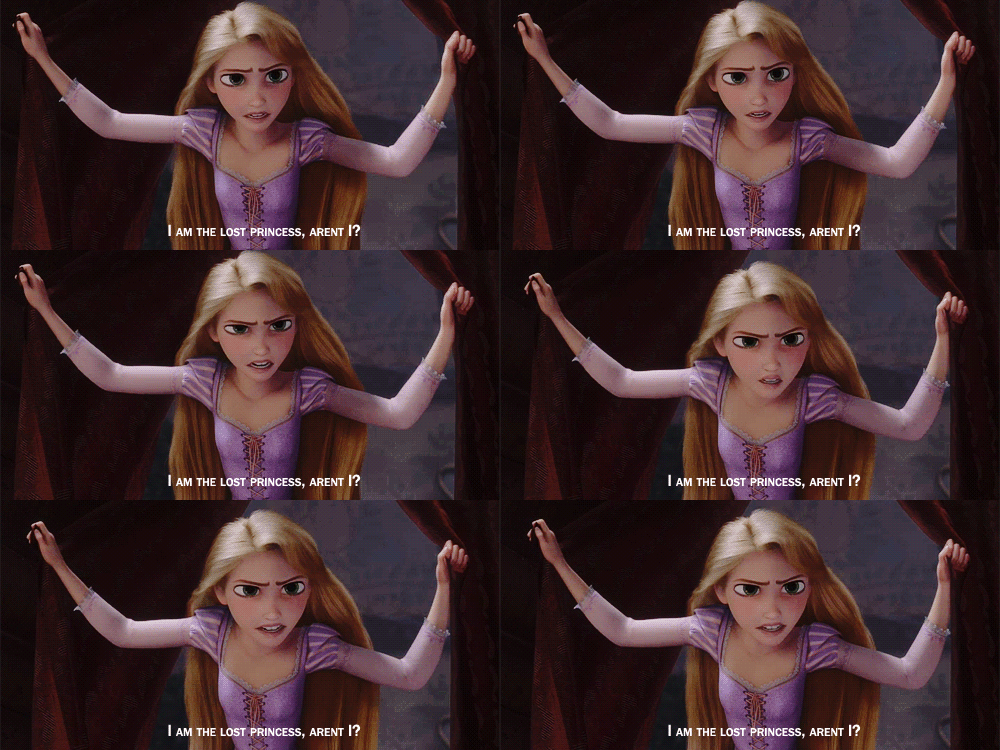
Or worse, look at you like this.
My characters didn’t know why they were there. I didn’t know why they were there either. I had no clue what they were supposed to be doing, so I’d start throwing random instructions at them: “Fight, characters! You guys should fight now! Maybe fighting will make this event have a purpose!” Which inevitably resulted in characters going through the motions of battle for no apparent reason, like they had all lost their minds.
What was the problem? I didn’t know how to write a scene. I didn’t know what a scene was. I had a vague definition that it was something about changing scenery, or just “something happening”.
It’s not. And once I learned what a scene was, my characters got to stop pummeling each other, while wishing they could pummel me.
So what is a scene?
The definition of a scene is kind of like the definition of a story. Story is change, a massive change in the life of your main character. A scene is change too, but much smaller, and part of that huge story change. You couldn’t have the BIG change without these tiny changes. Thus, a scene is not switching scenery. It’s not flipping to a new Character’s POV. It’s one segment of change, which triggers the next change, which triggers the next, which gradually build into sequences, which build into Acts, which build into story.
So what goes into a scene? How does it work?
1. Alternating Charges
If a scene opens positive, it will turn negative by the end. If it opens negative, it will end positive. Simple.
2. Character Goals
Everybody in a scene wants something. If they don’t want anything, they shouldn’t be in the scene. And these characters, with their often opposing goals, are going to employ different tactics on each other to get what they want. Which creates …
3. Escalating Conflict
Conflict is created when one character wants one thing and another wants something else, right? So the characters in the scene are each pushing for something different, each new tactic increasing in determination. And what are these actions called?
4. Beats
The beats of a scene are exchanges of action and reaction. One character does something, another character reacts. All exchanges (beats) are pushing the scene onward, building tension and conflict, until finally …
5. Turns & Revelations
The scene turns. The positive has changed to negative. Something has been discovered. The story has spun in a new direction.
6. Connection to Story Objective
Every scene must be connected to the BIG goal of the story, the main character is taking small actions to reach that big goal. If it isn’t obviously connected to this big plot, it won’t make sense. Your reader won’t know why the heck they’re reading the scene. Which brings us to …
7. Logic & Necessity
Every scene must be necessary. It must be able to be linked with the previous scene. “Because that happened in the previous scene, THIS must happen in this scene.”
So! To see how that all works, let’s break down a scene from Tangled. (Because I used it in the last post to map out how a premise works, and my little writer heart can’t resist symmetry.)
Rapunzel’s Goal: Rise up against her mother – finally.
Gothel’s Goal: Regain control.
Escalating Conflict: They’re fighting over who controls Rapunzel, and this battle causes them to go from “mother and daughter” to “enemies”. The conflict builds nicely in this scene, causing the story turn.
Connection to Story Objective: Throughout the movie, the big thing Rapunzel wants is freedom, she wants her life to begin, she wants to have a new dream. This is the moment she figures out how to do that; it’s not escaping the tower, it’s escaping Gothel’s control over her.
So! Here’s the scene.
Beat 1
“Rapunzel? Rapunzel, what’s going on up there?”
Ignores her. Still processing the tremendous implications of this revelation.
Beat 2
“Are you alright?“
“I’m the lost princess.” (Dumbfounded. Almost whispering it to herself.)
Beat 3
“Oh, please speak up Rapunzel! You know how I hate the mumbling.” (Bullying.)
“I am the lost princess! Aren’t I?” (Fighting back. She will not be bullied anymore.)
Beat 4
Gothel stares, stunned. She’s rendered temporarily speechless, because her secret’s been revealed finally, and her victim is actually fighting against her.
“Did I mumble, Mother? Or should I even call you that?” (Accusing. Drawing herself up taller. Looking down on Gothel and glaring. She’s seeing her clearly for the first time in her life.)
Beat 5
After a pause, thinking up a tactic. “Oh, Rapunzel, do you even hear yourself? How could you ask such a ridiculous question?” (Laughs. Ridicules. Attempts to make her feel childish, dumb, worthy of being mocked. Tactics which have always worked. She even begins to hug her.)
Rapunzel pushes her. “It was you! It was all you!” (Still accusing and angry, but pain is beginning to show. It’s almost like she’s giving her a chance to explain herself.)
Beat 6
“Everything I did was to protect you.” (And Gothel doesn’t say anything redeeming. She’s holier than thou, regal, bestowing kindness on an ungrateful, stupid child. Trying to control through guilt.)
Rapunzel rams her out of the way.
Beat 7
“Rapunzel!” (Shouting. Now trying anger.)
“I’ve spent my entire life hiding from people who would use me for my power …” (Leaves her.)
Beat 8
"Rapunzel!” (Still trying the anger angle.)
“But I should have been hiding from you.” (Throwing the truth at her.)
Beat 9
“Where will you go? He won’t be there for you.” (She’s tried everything else. It’s time to attack her heart.)
“What did you do to him?” (Fear)
Beat 10
“That criminal is to be hanged for his crimes.” (She’s keeping up the disapproving mother act, but striking her right where it will hurt her most.)
“No.” (She’s stopped. Shrinking in on herself. Staring, horrified. And Gothel thinks she’s won.)
Beat 11
“Now, now. It’s alright. Listen to me. All of this is as it should be.” She goes to pat Rapunzel’s head, a gesture symbolic of her superiority, her physical, mental, and emotional control over her victim.
Rapunzel grabs Gothel’s wrist. “No! You were wrong about the world. And you were wrong about me! And I will never let you use my hair again!"
Beat 12
Gothel wrenches free, stumbling backwards in shock and anger, breaking the mirror in the process.
"You want me to be the bad guy? Fine. Now I’m the bad guy.” (Well, now emotional control is over. It’s time to start stabbing Rapunzel’s boyfriend.)
This action has no reaction, interestingly. It leaves us hanging, a cliffhanger created with only beats.
Closing Charge: Negative. She’s now a full-fledged villain, the motherly persona shed, and she’s determined to get what she wants whatever the cost.
Turn: It changed from positive to negative, and now we’ve got a Flynn-stabbing witch to deal with.
Revelation: She’s always been evil. She has always been the bad guy. The motherly act was just that, an act.
Logic & Necessity: This scene fits with the previous scene, and the one that follows.
Though I’ve seen these concepts in many books, the place I first learned about it (and the best resource for scene design in my opinion) is the book Story by Robert McKee. It’s helped me countless times, is one of my favorite books on storytelling, and I highly recommend it if you write anything.
I realize that these definitions were a little vague, so I’ll be explaining things more thoroughly in subsequent posts.
“We Wear Culture” is a collaboration between Google and more than 180 museums, schools, fashion institutions, and other organizations from all parts of the globe. It’s part of Google’s Arts & Culture platform, which is digitizing the world’s cultural treasures, and functions as a searchable guide to a collective archive of some 30,000 fashion pieces that puts “three millennia of fashion at your fingertips,” Google says.
But it isn’t just a database. Google has worked with curators to create more than 450 exhibits on different topics—say, how the cheongsam changed the way Chinese women dress—making the site an endlessly entertaining, educational portal filled with stunning imagery touching on everything from modern Japanese streetwear to the clothes worn at the court of Versailles.
i can already tell this has made writing for historical fandoms – the worst part of which, for me, is absofuckinglutely hands-down the clothing – much easier.
*pterodactyl screech* Reblogging for all of you writers!!!
When writing speculative fiction, one of the writer’s most important jobs is to establish the new rules for their world. In many branches of speculative fiction, especially fantasy and even horror, this is magic, though it can also be technology and alternate scientific rules for science fiction. Whatever alternate fact(s) or reality you utilize to make your fictional world possible, that qualifies as a “magic system.” Your magic system is most often defined by what it can’t dorather than by what it can.
Why do I need a magic system?
When writing speculative fiction, it’s usually assumed that something about your world is different than ours. That can be a small tweak or it can be a complete dismantle-and-reassembly of physics as we understand it. Whatever system you choose to implement, it needs to have internally consistent rules. If, throughout the course of your book, magics begin to contradict each other, then it will disturb your readers suspension of disbelief. You don’t want your awesome magic to yank your readers from the believability of the story. But…most important of all…you have to establish some sort of rules and limits in order to prevent yourself from pulling a deus ex machina. No one likes a poorly executed deus ex machina. Few people like a well executed one (is there such a thing?). If you have rules, limits, cost, built into the magic or technology of your world, then you establish something that is not only nuanced and interesting, but believable.
But…but…it’s magic!!!
Why write speculative fiction if I have to create and follow all of these tedious rules?! The real world has rules enough.
It’s true. But following your own rules and following real worlds aren’t the same thing. Lots of you have probably heard the little saying, “Give your world a Flux Capacitor.” If you think about it, Back to the Future’s Flux Capacitor doesn’t make a lot of sense. It’s not explained. But we accept it because it’s magic. And when Doc says, “Here’s this thing. It makes time travel possible.” We accept it because it’s a simple alteration. He doesn’t try to use it to do more than what is initially established. It never breaks that rule. It’s not used to get Marty out of an impossible situation, defying any previous understanding of the technology. That’s why it works.
So where you do start?
First, you need to probably choose what type of magic you will use. Will be elements based? Or energy based? Spirit? Physical? Time and Space? What things is your magic summoning/manipulating/drawing from?
Now you’ll want to focus on the parts that make your magic yours. Sure, elemental magic has been used half a zillion times, but it can still be interesting if you do something new with it. The best way to do something new is to alter its limits, change the cost, give it a new spin that makes your regular ol’ fire magic something intriguing.
You can do a little bit of research into ancient forms of magic, into other literary uses of magic. See what those before you have done and use it as an inspiration.
If you’re having trouble knowing where to start, I’m here to provide you some thoughts concerning the skeletal-assembly of your magic system! Use these prompts as you see fit!
What does magic use/alter/manipulate?
visible energies
gravity
laws of physics
light
thought
water, only, in all of its forms
fabric of space
elementary particles
items of specific color or texture
perception
plant life
the dead
blood
magnetic forces
demons
vibrations
earth
emotions
Who possesses magic?
scholars
children
random lucky people
anyone
everyone
the elderly
anyone who’s ever petted a dog
specific animals
deities
How is it acquired?
at birth
intense study and training
gifted
through random action
through a ritual
as one ages
stolen
From where is power drawn?
internal mana
heat energy
alignment of the stars
physical contact with _____ (the earth, another life force, a drawing or rune)
I made these as a way to compile all the geographical vocabulary that I thought was useful and interesting for writers. Some descriptors share categories, and some are simplified, but for the most part everything is in its proper place. Not all the words are as useable as others, and some might take tricky wording to pull off, but I hope these prove useful to all you writers out there!
As Tumblr isn’t exactly the best platform for retrieving older posts, I’ve decided to create an Index Page to help keep track of the project. I’ll link to this page in the header so that it’s always easy to find. Think of this as our table of contents. Every time I post something new, I’ll add a link to it here, sorted by category. That way if you’ve missed an assignment, are searching for a specific resource, or even just want to know how everyone did during their challenge week, you’ll be able to find it here.
Writers can use these 12 Archetypes to create characters
The 12 Common Archetypes by Carl Golden
The twelve archetypes are divided into ego types, self types, and soul types.
1) The Four Ego Types
1. The Innocent Motto: Free to be you and me Core desire: to get to paradise Goal: to be happy Greatest fear: to be punished for doing something bad or wrong Strategy: to do things right Weakness: boring for all their naive innocence Talent: faith and optimism The Innocent is also known as: Utopian, traditionalist, naive, mystic, saint, romantic, dreamer.
2. The Orphan/Regular Guy or Gal Motto: All men and women are created equal Core Desire: connecting with others Goal: to belong Greatest fear: to be left out or to stand out from the crowd Strategy: develop ordinary solid virtues, be down to earth, the common touch Weakness: losing one’s own self in an effort to blend in or for the sake of superficial relationships Talent: realism, empathy, lack of pretence The Regular Person is also known as: The good old boy, everyman, the person next door, the realist, the working stiff, the solid citizen, the good neighbour, the silent majority.
3. The Hero Motto: Where there’s a will, there’s a way Core desire: to prove one’s worth through courageous acts Goal: expert mastery in a way that improves the world Greatest fear: weakness, vulnerability, being a “chicken” Strategy: to be as strong and competent as possible Weakness: arrogance, always needing another battle to fight Talent: competence and courage The Hero is also known as: The warrior, crusader, rescuer, superhero, the soldier, dragon slayer, the winner and the team player.
4. The Caregiver Motto: Love your neighbour as yourself Core desire: to protect and care for others Goal: to help others Greatest fear: selfishness and ingratitude Strategy: doing things for others Weakness: martyrdom and being exploited Talent: compassion, generosity The Caregiver is also known as: The saint, altruist, parent, helper, supporter.
2) The Four Soul Types
5. The Explorer Motto: Don’t fence me in Core desire: the freedom to find out who you are through exploring the world Goal: to experience a better, more authentic, more fulfilling life Biggest fear: getting trapped, conformity, and inner emptiness Strategy: journey, seeking out and experiencing new things, escape from boredom Weakness: aimless wandering, becoming a misfit Talent: autonomy, ambition, being true to one’s soul The explorer is also known as: The seeker, iconoclast, wanderer, individualist, pilgrim.
6. The Rebel Motto: Rules are made to be broken Core desire: revenge or revolution Goal: to overturn what isn’t working Greatest fear: to be powerless or ineffectual Strategy: disrupt, destroy, or shock Weakness: crossing over to the dark side, crime Talent: outrageousness, radical freedom The Outlaw is also known as: The rebel, revolutionary, wild man, the misfit, or iconoclast.
7. The Lover Motto: You’re the only one Core desire: intimacy and experience Goal: being in a relationship with the people, work and surroundings they love Greatest fear: being alone, a wallflower, unwanted, unloved Strategy: to become more and more physically and emotionally attractive Weakness: outward-directed desire to please others at risk of losing own identity Talent: passion, gratitude, appreciation, and commitment The Lover is also known as: The partner, friend, intimate, enthusiast, sensualist, spouse, team-builder.
8. The Creator Motto: If you can imagine it, it can be done Core desire: to create things of enduring value Goal: to realize a vision Greatest fear: mediocre vision or execution Strategy: develop artistic control and skill Task: to create culture, express own vision Weakness: perfectionism, bad solutions Talent: creativity and imagination The Creator is also known as: The artist, inventor, innovator, musician, writer or dreamer.
3) The Four Self Types
9. The Jester Motto: You only live once Core desire: to live in the moment with full enjoyment Goal: to have a great time and lighten up the world Greatest fear: being bored or boring others Strategy: play, make jokes, be funny Weakness: frivolity, wasting time Talent: joy The Jester is also known as: The fool, trickster, joker, practical joker or comedian.
10. The Sage Motto: The truth will set you free Core desire: to find the truth. Goal: to use intelligence and analysis to understand the world. Biggest fear: being duped, misled—or ignorance. Strategy: seeking out information and knowledge; self-reflection and understanding thought processes. Weakness: can study details forever and never act. Talent: wisdom, intelligence. The Sage is also known as: The expert, scholar, detective, advisor, thinker, philosopher, academic, researcher, thinker, planner, professional, mentor, teacher, contemplative.
11. The Magician Motto: I make things happen. Core desire: understanding the fundamental laws of the universe Goal: to make dreams come true Greatest fear: unintended negative consequences Strategy: develop a vision and live by it Weakness: becoming manipulative Talent: finding win-win solutions The Magician is also known as: The visionary, catalyst, inventor, charismatic leader, shaman, healer, medicine man.
12. The Ruler Motto: Power isn’t everything, it’s the only thing. Core desire: control Goal: create a prosperous, successful family or community Strategy: exercise power Greatest fear: chaos, being overthrown Weakness: being authoritarian, unable to delegate Talent: responsibility, leadership The Ruler is also known as: The boss, leader, aristocrat, king, queen, politician, role model, manager or administrator.
Note: There are four cardinal orientations: freedom, social, ego, order. The types have a place on these orientations.
The Three Levels of Conflict, from STORY: Substance, Structure, Style, and the Principles of Screenwriting by Robert McKee, pg. 146
Mckee writes that
“STORY is born in that place where the subjective and objective realms touch” (147). We know from our earlier explorations of Narrative Structure and Character that story is driven by the Protagonist. It is the Protagonist’s search or desire for what she wants that motivates her actions in the story“
this in turn creates a dramatic narrative in which both the Protagonist and the world in which the Protagonist operates are transformed on some level.
The difficult thing about British slang is that it differs depending on region, and you have words that are carried locally if they’re not succeeded by a national phrase – so a word might be Mancunian in origin, but may spread to other areas as people move around.
So part of the issue depends on where you place Snape, and who he is talking to, and when it is/was. For instance, 20 years ago I might have said something good was mint or sound or wicked, but I wouldn’t really do so now. If you’re writing phonetically, you might want to consider how words are pronounced with an accent. Some are easier to transcribe than others, such as the dropping of a ‘h’ or ‘g’ sound, or t-glottaling, or omitting ‘to’ – or depending on the setting, you might change how the word is said in informal terms…say, for example, right is also reet.
These are all words/phrases that stem from around where I am:
coss – tell off
mither – bother kaylied / rat arsed – drunk mooch – wander aimlessly skive – avoid without permission cadge – beg shufty – glance dock off – massive lozzock – lay about sorted – fixed narked – irritated scrikin – crying owt – anything nowt – nothing scruff – unkempt person mucker – mate neck – quickly down a drink caned – quickly consume
muggins here – foolish me do one – go away cob on – sulk filch – pinch (as in steal – but only something minor, e.g. filch a pen) mard (mardy / mard-arse) – sulking brassic – skint slat, chuck – throw maul – heave with difficulty scran / grub – food brew – cuppa canny – smart good hiding – belting / beating kecks – trousers in all / and all – as well gawp – stare rudely without shame cop off / get off – pull (a person) hanna – have not dancers / wooden hill – stairs mush / chops – mouth grots – sweets clobber – clothes doddle – easy us – me (as in ‘give it us’) snicket – alley clocked – noticed kip – nap bobos – sleep (used with kids especially) tra – bye heckers like – definitely not, used scornfully
If I’m honest, I’d definitely try and hit up someone who is from / lives in the region where you’re trying to place the characters, and just get them to check it over to see if it scans.




 Glube Fics